
Many firms have adopted automation tools and technologies with great fervor and have seen success in selective projects. Yet, according to a study conducted by Ernst & Young, 30% to 50% of automation projects still fail. Many firms also struggle to scale automation at the enterprise level.
I have had the privilege of setting up enterprise-level automation and process centers of excellence (COEs) for firms like Bank of America, United Healthcare and most recently at LexisNexis, where I learned hard lessons about what factors inhibit the success of automation and resulting scalability. From these lessons, a clear Enterprise Intelligent Automation Roadmap has emerged, a step-by-step model which can help most organizations achieve holistic and sustainable success.
Enterprise challenges for automation success
A broad array of automation tools has evolved over the past few years, complicating automation's adoption and success rate within enterprises. Every tool was built to address a particular class of automation needs, which are broadly defined by the type of data handled, nature of the process (variability), and predictability of the outcomes (whether it's highly predictable work like simple data entry or more complex research or editorial work where the outcomes vary by who is performing the task). The following graph shows the broad nature of tools and how they align to work patterns.

Image by author
Often particular tools, like robotic process automation (RPA) or business process management (BPM), are chosen and pushed as the holy grail for automation with no upfront assessment of their suitability or capabilities. This is due partly to a lack of knowledge within implementation teams and partly to a push from top executives to justify large investments committed to a particular tool.
For example, a senior executive might have signed a multi-million-dollar, multi-year license deal with a particular automation vendor. They want to justify the investment by pushing the tool across as many projects as possible. This is when we start to see failures — and as a result, disillusionment with automation at large.
Another crucial factor that has impacted automation is the culture and discipline of process-driven operations. While the evolution of technologies has broadened automation's scope and application, the underlying ability to discover, analyze and optimize business processes has not seen much progress until the last five to seven years. The ability to discover current state processes and analyze various KPIs, bottlenecks and patterns is key to successful automation, while the failure to scale can be broadly assigned to the seven critical factors explained below.
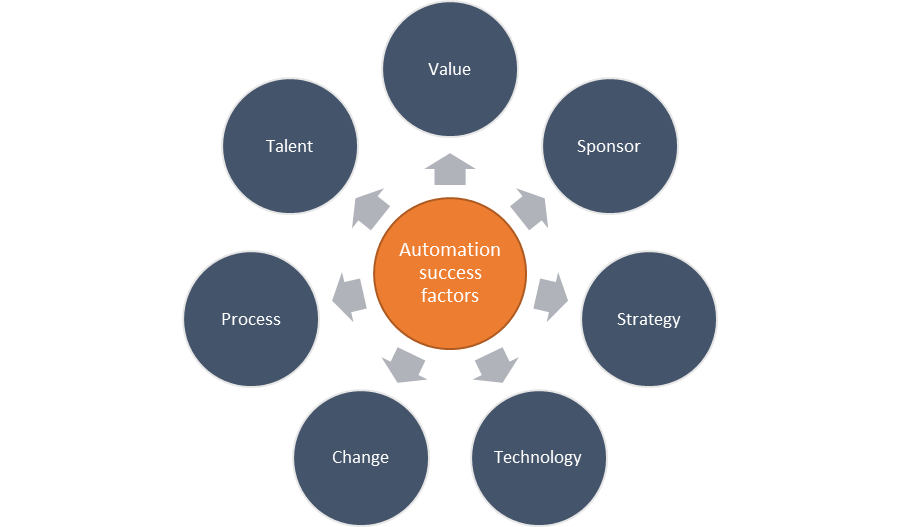
Image by author
Value: Lack of a metrics-driven approach to problem discovery and building a solid business case can impede success. The absence of demonstrable impacts after an automation project also contributes to the loss of continued sponsorship and funding.
C-suite sponsorship: When a select few junior leaders implement automation projects without C-suite commitment, we will see departmental success with automation but never enterprise-level adoption.
Alignment to strategy: When automation is not aligned to corporate strategies that impact profitability, customer experience or revenues, automation loses steam as it will fail to get the required investments of time and money.
Technology and architecture: Lack of holistic technology architecture that combines data, integrations, user experience, and automation-pattern-based standards results in standalone automations that often incur tech debt.
Change management: Automation brings changes across people, processes, operations, systems, data, user interfaces, organization models, and roles, and when undermined, it ends with failed user adoption or backlash from IT and business stakeholders.
Process excellence: Lack of a disciplined approach to current state discovery, analysis, standardization, measurement of KPIs, and designing target state processes is a very common reason for the failure of automations.
Talent: Most firms don’t identify and invest in acquiring or developing the right level of skills across process, technology, change, and program management, which results in the inability to deliver repeatable success in automation.
Pillars of enterprise automation
The seven critical factors that lead to automation failures need to be addressed holistically and not on a gradual basis. Automation success boils down to five core principles:
Enterprises will usually go through a phased evolution in their intelligent automation journey, and their adoption of the principles will improve as they continue to demonstrate incremental value with each project. The Enterprise Intelligent Automation Roadmap brings all the principles together in a phased manner, aligned to the three phases of maturity that every enterprise typically goes through. The next section explains the key phases of this roadmap with suggested outcomes.
Enterprise intelligent automation roadmap
Phase 1: Define
The “Define” phase is the formative phase where:
When successful, there is a clear alignment across all executive stakeholders about the role, value and applicability of automation.
Phase 2: Standardize
The “Standardize” phase focuses on creating repeatable models for:
When successful, automation becomes a key component of enterprise business transformation programs and every automation project is delivered with predictable outcomes.
Phase 3: Scale
The “Scale” phase is the continuous optimization and expansion phase, where the focus is on achieving efficiencies of scale and standardization, resulting in:
When successful, this phase marks the highest level of sustainable success for an enterprise where demonstration of innovation, delivery and value become ingrained into operating models.
Automation continues to be a key part of digital transformation for most global firms. Firms that approach automation with a holistic view that brings together technology, people, process, organization, and change management are the ones that will derive sustainable and scalable value. The enterprise automation roadmap is a journey and not a point-in-time exercise and will differ for each organization. An agile approach is recommended, where every step is calibrated with the progress of each phase.
Vinay Mummigatti is EVP of Strategy and Customer Success at Skan AI.
Welcome to the VentureBeat community!
Our guest posting program is where technical experts share insights and provide neutral, non-vested deep dives on AI, data infrastructure, cybersecurity and other cutting-edge technologies shaping the future of enterprise.
Read more from our guest post program — and check out our guidelines if you’re interested in contributing an article of your own!