Specifications enable native photon routing, with the potential for up to 40× better network energy efficiency and 75% fewer optical transceivers in AI networks
SUNNYVALE, Calif.--(BUSINESS WIRE)--October 20, 2026--
Resolight.ai the pioneer of nanosecond OCS for the AI data plane, applauded CPO specifications from the Advanced Photonics Coalition (APC) addressing the protocol integration needed to enable native photon routing through nanosecond optical circuit switching (OCS). The specifications were announced today at the Optica + APC PECC Summit, establishing a standards foundation for dramatically more efficient AI networks.
This press release features multimedia. View the full release here: https://www.businesswire.com/news/home/20261020481975/en/
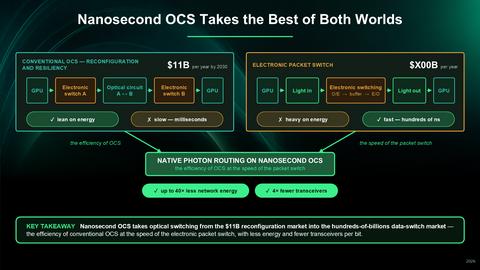
Resolight’s architecture targets up to 40× better network energy efficiency and up to 75% fewer optical transceivers in multi-rack AI scale-up networks. These improvements can reduce networking power, hardware requirements and infrastructure footprint, helping improve the economics of delivering AI workloads.
The announcement comes as the industry confronts a fundamental challenge: making AI economically sustainable at scale. In its recent analysis, McKinsey identifies the cost of serving AI as a barrier to widespread adoption, highlighting the energy and latency costs of moving data as a target for semiconductor innovation. Delivering more useful AI output per dollar requires improvements across the system—including the network connecting its accelerators. Nanosecond OCS brings a new architectural opportunity to that challenge.
What is Nanosecond OCS?
Conventional OCS reconfigures optical connections, while electronic switches typically continue to handle data switching. Native photon routing extends optical switching into the data plane itself, directing coordinated data transfers through the network while keeping their payloads in the light domain.
By avoiding repeated optical-to-electrical-to-optical conversions, Resolight’s architecture targets up to 40× better network energy efficiency and up to 75% fewer optical transceivers in multi-rack AI scale-up networks. These improvements can reduce networking power, hardware requirements and infrastructure footprint, helping improve the economics of delivering AI workloads. Actual benefits depend on topology and implementation.
Optical supply constraints add urgency to this opportunity as AI infrastructure expands.
Alongside essential investment in manufacturing capacity, reducing the optical hardware needed per network offers an architectural way to ease that pressure. By eliminating up to three quarters of transceiver requirements, Resolight aims to reduce the components operators must source and deploy, helping them scale AI networks with less hardware and power.
“The industry needs more than faster connections—it needs a more efficient way to move and switch data with economics and a real plan to scale AI data center requirements” said Ofer Shapiro, CEO and co-founder of Resolight. “We have seen tremendous interest, excitement, and discussion around nanosecond OCS and native photon routing. APC’s CPO specification marks an important milestone: connecting photonic engines with the protocol coordination needed to make this architecture practical.”
“For the first time, the industry has produced specifications addressing not only photonic engines but also the data-plane integration required for nanosecond native photon routing. This moves the discussion beyond how to switch light, to how endpoints and network elements work together to deliver data reliably at nanosecond switching speeds,” continued Shapiro. “The APC CPO specifications address the data-plane integration needed to make native photon routing a practical alternative to electronic data switching.”
By coordinating endpoints and network elements for nanosecond optical switching, APC extends the advantages of photonics beyond the interconnect link and into the network itself. Keeping information in the light domain enables multi-rate scale-up networks with higher density, lower power consumption and the potential to reduce transceiver count by a factor of four.
Key Differentiation
Making nanosecond OCS practical requires more than a fast optical switching mechanism. Endpoints must coordinate transmission windows, manage contention and ensure receivers are ready for incoming bursts. Resolight brings nanosecond switching and networking-protocol coordination together to address that system-level challenge.
Without both nanosecond switching and data-plane integration, an optical fabric cannot provide the coordinated, burst-by-burst data-switching functionality targeted by Resolight. Conventional OCS are falling short of delivering the switching time required to replace a packet switch and packet switches with the most advanced interconnect requiring more power than the OCS. Resolight’s approach targets both data-switching latency and energy consumption.
Dell’Oro Group
Extending optical switching into the data plane also opens a substantially larger commercial opportunity. Dell’Oro Group forecasts nearly $1 trillion in cumulative AI back-end switch spending during 2026–2030. Resolight believes native photon routing can expand optical switching’s addressable opportunity by orders of magnitude, making it a contender for appropriate functions within this broader market.
“AI networking reached an inflection point this year, as switch sales for AI back-end networks overtook front-end networks for the first time in the second quarter. Architectures that keep data in the optical domain, cutting the number of conversions and transceivers in each network, are among the approaches that could help operators scale AI infrastructure more efficiently and economically. Making that shift requires the whole ecosystem to work together, which is why the Advanced Photonics Coalition’s new specification for Co-Packaged Optics includes nanosecond optical circuit switching in the AI data plane as an important step toward broader adoption,” said Sameh Boujelbene, Vice President at Dell’Oro Group.
Raymond James
In a Raymond James private company profile Resolight - Waveguide Optical Switch Vendor Targeting Scale-Up Switching, authored by Simon Leopold, Jeff Koche and Victor Chiu and published on July 30, 2026, the company shared, “While not yet proven and facing standardization and manufacturing hurdles, if successful, Resolight’s technology could disrupt or partner with today’s leaders exposed to AI switching fabrics such as NVIDIA, Broadcom, AMD, Marvell, Arista, Cisco, HPE and perhaps even optical suppliers like Lumentum and Coherent.”
Resolight invites accelerator developers, optical interconnect providers and network platform partners to collaborate on interoperable systems that bring native photon routing into AI infrastructure.
About Resolight
Resolight is a native photonic routing company developing nanosecond optical circuit switches for AI networks. By combining optical switching with endpoint and protocol coordination, Resolight aims to overcome networking bottlenecks, improve energy efficiency and reduce the optical hardware required for multi-rack scale-up. Learn more at resolight.ai
View source version on businesswire.com: https://www.businesswire.com/news/home/20261020481975/en/
Media:
info@resolight.ai