
Whenever a company enforces a security patch, it is the workers who suffer from disrupted workflows. Well, not anymore. Today, Atlanta-based Amplifier Security emerged from stealth with a mission to address corporate security gaps with AI and human-in-the-loop automation. The startup also announced $3.3 million in pre-seed funding, led by Cota Capital with participation from multiple other VCs and tech industry luminaries, including the founders of Slack, Skyflow and Mercury.
While there are many tools to automate security gaps for enterprises, Amplifier, founded by former BetterCloud executives Shreyas Sadalgi and Thomas Donnelly, is taking a different approach: self-healing. Essentially, the company is using AI and automation to create an ecosystem where users could self-heal common security issues on their end – without breaking their workflows.
The company is already implementing the product with multiple organizations, including Guardant Health, Instabase, Oscar Health and Zemoso. It has plans to use the fresh capital to scale the product to more enterprises.
Self-healing security with AI
Implementing security at the enterprise level takes a lot of work. Most teams maintain a massive stack of tools to keep their organization safe, but more often than not, coverage gaps and alerts across these tools — be it the installation of a security patch or answering questions about suspicious behaviors – do not get thorough and timely attention from the workforce. Workers are mostly busy with their respective projects and they do not prioritize security gaps, leaving a major gap between what’s needed to be done and what’s actually done to ensure full security coverage.
Now, most security teams try to solve this last-mile challenge by constantly cat-herding employees, manually chasing them down to close the loop (which is next to impossible when operating at scale), or using automations to brute-force the fixes. This disrupts the stream of work and sometimes even strains the relationship between the security team and the rest of the workforce.
“Security tools & teams mostly operate in the background, and engaging the workforce on security issues always feels like an interruption – for both parties. The lack of such real-time human engagement is also a missed opportunity to educate people on “the why” behind the risk of each such security finding and gap. Because of today’s hybrid and dynamic workplaces where everyone is moving fast in the spirit of hyper-productivity, this problem has become harder to solve at scale,” Sadalgi, who saw the issue first-hand after leaving BetterCloud, told VentureBeat.
To address this, he and Donnelly came up with Amplifier, a SaaS platform that brings together data from all security tools an organization has in place and uses AI-powered personalized engagements to help employees understand the impact of any gaps they may have and how to self heal them — without impacting day-to-day productivity.
At the core, Amplifier achieves this with three key components: a security data fabric, a security hub and an engagement studio.
The data fabric integrates with and ingests data from all security tools an enterprise maintains and creates a real-time security data graph of the organization, covering each tool across different employees and departments. The security hub leverages this data graph to create personalized security health scores and dashboards, enabling a way to understand the overall security posture of the organization, the coverage of the tools in use (planned vs actual) and the riskiest departments and users within the organization – complete with information about what’s putting them at risk.
When the risk elements as well as the core issues are identified, the engagement hub comes into play, allowing security teams to create and manage personalized engagements to help vulnerable users fix existing problems, at their convenience. It provides security admins with a drag-and-drop interface to define various aspects of the engagement, right from where the message should go (Slack or any other preferred channel), what it should sound like and the frequency of reminders to providing options for resolving the issue right away or scheduling a meeting to work on it later.
On the users’ side, these engagements are delivered in a personalized manner via Ampy, an AI copilot that combines conversational interaction with real-time insights from the security data fabric.
“Building on the experiences people are used to, for example with credit card companies verifying suspicious transactions, Ampy engages with employees, guiding them through security protocols based on real-time insights. Ampy personalizes engagements that help employees triage alerts and self-heal security issues with context and actionable information. Ampy transforms how employees interact with corporate security tools in conversational two-way interactions,” Sadalgi explained.
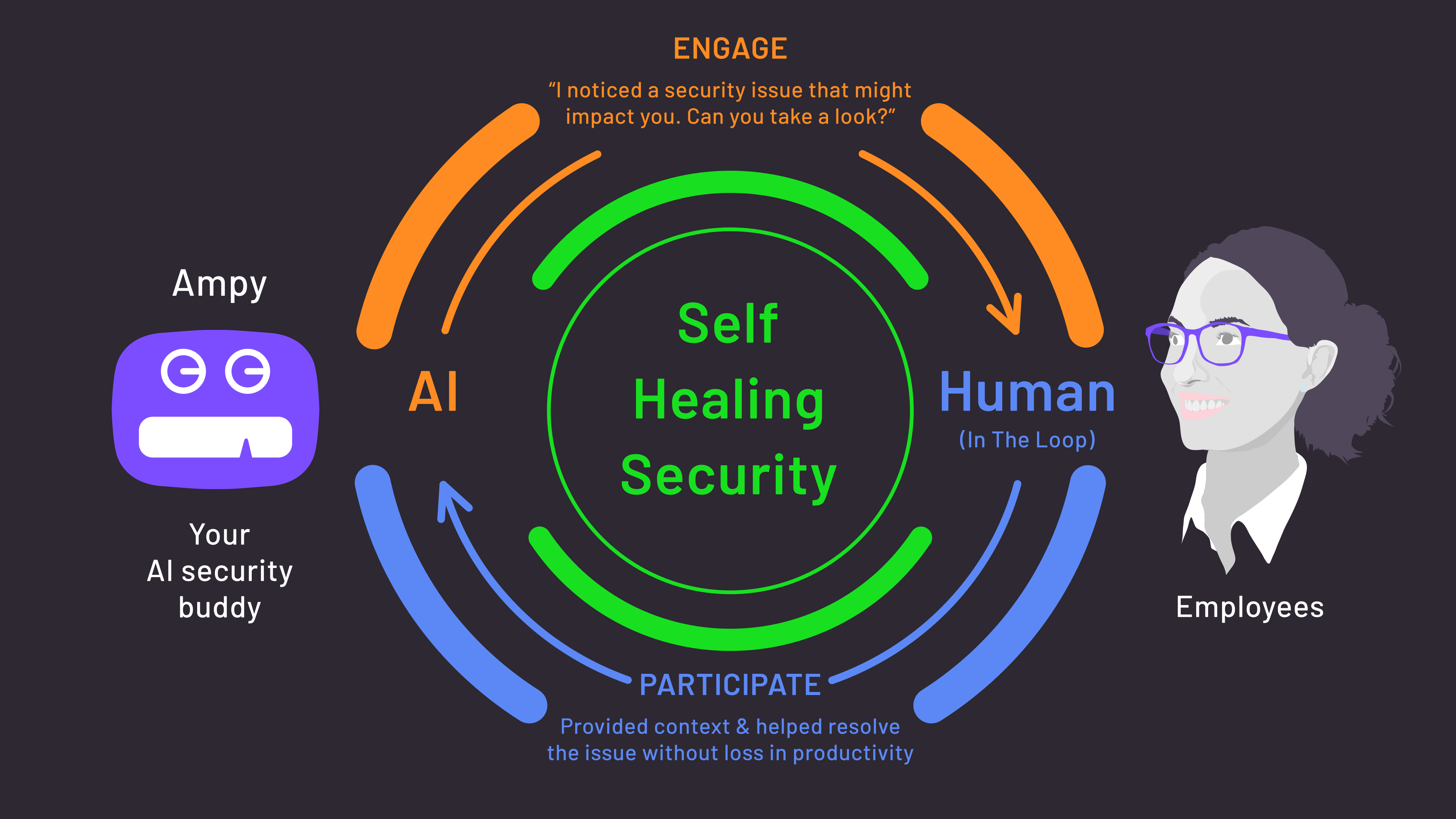
How the Amplifier Security platform works. Credit: Amplifier Security
As a result, security teams no longer have to cat-herd across to get issues fixed, while workers get a ready-to-assist copilot that not only involves them in the security process but also gives them the flexibility to act on time without affecting workflows. According to the CEO, this approach can easily enable companies to maximize the value of their existing security stack and amplify their security posture and culture to levels not achievable in the past.
Plan ahead for Amplifier
While Amplifier has just emerged from stealth, it has been engaged with security teams at more than 15 companies to design its product. Seven of these partners, including Guardant Health, Skyflow, Instabase, Oscar Health, BetterCloud and Zemoso, have also converted into early customers of the company.
Sadalgi did not share specifics of how these enterprises are tapping the Amplifier platform but he did note that one of the customers used Amplifier to ensure security training compliance with a success rate of 87.94%. It even leveraged the copilot to help employees patch vulnerabilities. Amplifier found as many as 155 issues and the copilot “self-healed” more than half of them while working with employees through back-and-forth interactions, he said.
As the next step, Amplifier plans to use the funds raised to grow its team and build out the product to loop in more customers and take on other players in the space, including Zscaler-owned Avalor Security and Silk Security.
“Our strategy is to focus our GTM efforts on building a strong brand associated with modern security practitioners at iconic companies who are forward-thinking to experience, understand and articulate the pain points and differentiation of our solution. This type of brand awareness creates a movement and followership to drive peer-to-peer network effects,” Sadalgi said.